photos

Assignment One-B

The other half of Assignment One had the following parameters:

  • Use available light
  • Use a “normal” lens (in my case a 35mm, since I’m using a crop sensor camera)
  • Take 10-20 minutes for the session

I admit the purpose of the assignment was not entirely clear to me at first, but it has turned out to be a good lesson about lens selection.

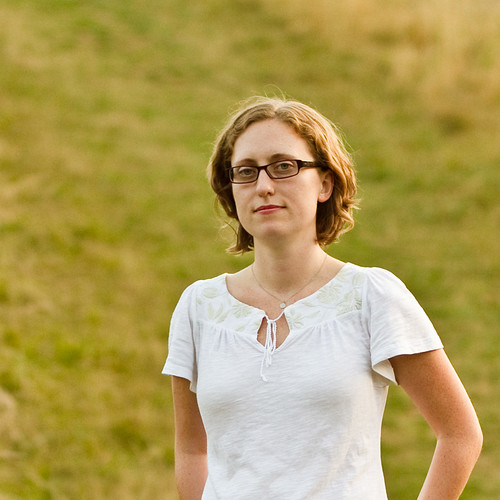
The day before I had the session with Kathy, my co-worker Don asked if I could take a head shot for him. I told him that, serendipitously, I needed a subject for this assignment and that we could easily combine the two. I chose to shoot after work, knowing that the light would be more flattering and predictable. We also decided to do it on our employer’s property, which has a some small patches of green, but is generally more functional than decorative. However I figured shooting there would be valuable experience, as more than likely I would have to photograph someone there again. Knowing the usable areas of the property will ultimately save me time and worry.

When I started photographing Don I felt something was off right away. It had nothing to do with Don, who was a cooperative and enthusiastic subject. It had to do with the combining of my assignment parameters and the request for a head shot. For the latter I would normally use the lens I used with Kathy – a 50mm, which puts some distance between myself and the subject, but not so much that it becomes difficult to provide direction. Using the 35mm and filling the frame with head and shoulders often put me uncomfortably close to Don, but it also resulted in slightly unflattering perspective distortion. The proximity lends the image a certain intimacy though, which could be valuable in some cases.

assignment2-8296.jpg

During the session I was also mindful of the light, as it was more overcast that day. Certain positions provided better catch lights in the eyes, which I didn’t notice as much as under eye shadowing. Ultimately I didn’t stay long at the second location, which I went to mainly to get more distance between Don and his background.

assignment2-8299.jpg

In the third location, which had some nice grass for a background, I took a few frames, but ultimately concluded the “normal” focal length wasn’t working out. Switching to the 50mm (and thereby ending the course assignment), I took several frames I knew would better suit Don’s head shot request.

assignment2-8320.jpg

Even though I wasn’t happy with the previous shots, it made for a good learning experience and I was prepared to turn in what I had. But with still a few days to go I figured it would be worth giving it another go, setting my sights on looser framing of my subject.

For “take two” I recruited another co-worker, Steve, and photographed him during our afternoon break. I had done a little scouting during my morning break and had a couple locations already in mind. Right away I noticed there would be (another) issue involving glasses, this time reflections. But I did my best to minimize them without giving up on the locations I had selected. With a busy highway on one side and some unattractive building “stuff” on the other, I wasn’t left with too many options.

assignment2-8328.jpg

Keeping a comfortable distance from Steve meant a slightly looser framing, although a somewhat aggressive crop basically shows what a longer focal length would have provided.

assignment2-8340.jpg

Ultimately I chose to do as little cropping as possible to uphold the spirit of the assignment.

assignment2-8340-2.jpg

If there’s one detail I would change (other than total elimination of eyeglass reflections), it’s the positioning of his far arm. Although visible, I think it could stand to have a little more showing (there’s the other issue of his shirt needing ironing, but I can only do so much).

Overall this more defined assignment has been a good one, providing a good lesson on lens selection and listening to my instincts.

Many thanks to Don and Steve for being my cooperative and patient subjects!

See the full set of photos from the sessions.

Standard
photos

Assignment One-A

This fall I signed up for an eight-week photography course through betterphoto.com. My motivation was to do a little more structured learning on the subject, since I’ve always been a good student – working well with deadlines and enjoying the classroom environment. The only difference now is the classroom is virtual – lessons, assignments and critiques are all done asynchronously through email and the Better Photo website. The course I’m taking is on digital wedding photography, which may seem pretty specific, but really the skills used during an event like that carry over to many different situations. While I’ve only started the class, I’ve been enjoying it all pretty well and look forward to what I’ll be learning this term.

For the first assignment, Instructor Paul F. Gero had us take a “simple and beautiful” portrait of a friend or family member. The parameters included:

  • Using my favorite portrait lens
  • Using the tools I feel most comfortable with (e.g. shooting with available light vs. flash)
  • Working within my comfort zone
  • Taking 10-20 minutes for the session

First off, a slight confession. I have always loved portrait photography, but at the same time have been somewhat intimidated by it. As an inherently shy person directing people and having to set them at ease does not come naturally to me. So there’s always been this sort of push-pull effect whenever I take a portrait, feeling incredibly hopeful about producing something pleasing or that properly captures someone, but so nervous if I don’t. While I feel this to an extent with anything I do, I’ve always been more sensitive about it when it comes to a portrait, perhaps because I see a lot of its success hinging on the subject’s own satisfaction with the image. In essence, I’m not happy unless they are happy.

So when I received the first assignment I was both excited and nervous. I asked my friend Kathy to be my subject and she kind of surprised me with how quickly she agreed to it. As it turned out, she was thinking of using a photograph on her business cards, but I imagine it also had to do with my bribing her with paraphernalia from our favorite TV show, “Buffy the Vampire Slayer.”

Buffy Panel to Panel

On the day of the shoot, we met at a local brew pub, took a little time to catch up, and then headed towards a nearby park. The sun was starting to set, which gave us some nice even light in spots, though I was a little anxious about the location since it was in an unfamiliar part of town for me and we didn’t have a lot of time to spend looking around. Fortunately after about a 10 minute walk I noticed an interesting spot that turned out to be a townhouse complex. The environments I thought were promising were a high retaining wall at the edge of the parking lot and a bench by the complex’s community center. I had already predetermined which lens, aperture and ISO I would be shooting with (a 50mm lens at f/1.8 at ISO 400), so I just pulled out my camera and started shooting. As Mr. Gero advised us to do, I spent enough time to lock in the exposure and then focused on interacting with my subject.

assignment1-8238-2.jpg

assignment1-8246.jpg

In the experience I’ve had taking portraits, there’s always been a slow build up of both inspiration and comfort for both subject and photographer. Working within the 10-20 minute time frame limits that progression, but it is often a scenario photographers find themselves in, so they have to make the most of it. Kathy was noticeably uncomfortable at first, which in turn made me uncomfortable since I didn’t really know how to put her at ease. But I kept shooting, putting her in a few different locations and trying a few different angles. Generally I tried to shoot at eye level or higher, but the steeper angles became slightly problematic because of the style of glasses she was wearing. The top of the frame intersected with the upper part of her eye, a detail I didn’t really notice until I was in the editing phase. I’m quite happy with the image otherwise, and am somewhat inclined to overlook the issue given the strength of the other elements. Either way, it is definitely one thing I will keep in mind in the future – how the style of eyeglasses can limit the acceptable angles I can shoot from.

assignment1-8252.jpg

After what we felt was 10 minutes (and it was uncannily close based on the file EXIF data – 10m04s!), it felt like we’d hit a natural break point and started walking back to our cars. Along the way a grassy hill with a wide swath cut through it caught my attention and I thought it would make for an interesting backdrop. Since I felt like I was working “after school” or in a time just for myself, I decided to switch to my favorite lens, an 85mm prime. Although I like a lot of the elements in the images from that location – the lighting, the color, and the composition – the detail that doesn’t quite work for me is Kathy’s hands being in her back pockets. It was her natural inclination, and I encouraged her to do it, but the angle isn’t quite right to pull it off. A more aggressive crop of the image eliminates the problem, but it also limits the size of the enlargement should one ever be made. So the second take-away involves the subject’s hands. In this particular situation, giving her something to hold like a blade of straw might have worked better, or simply varying the hand position until something worked.

assignment1-8281.jpg

assignment1-8288.jpg

After officially ending the session, I asked her how the experience was for her and she described how she felt awkward most of the time and how that might have been more so because we’re friends. I suspect it had to do with a change in our usual dynamic, and not enough time to settle into it. She couldn’t think of anything I could have done differently, since she didn’t feel she would have responded well to my being overly engaging or directive. This was somewhat intentional on my part, having read an article recently about letting subjects naturally settle into a position with only minimal direction. It’s a philosophy that ultimately suits my personality as well as what I perceive thus far as my style.

Although Mr. Gero asked us not do anything with the photos until the next day, my paranoia about losing data prompted me to at least get the images copied to my computer. Of course, once that step is taken, it’s hard to resist making selections, which then leads to edits. I did take some time to decompress though, doing a bit of mindless window shopping before actually going home.

Overall I’m pleased with the results of the session, having one or two images I think flatter Kathy and capture her personality, as well as a couple of things to be mindful of next time. Of course I didn’t feel like there was quite enough time to get into a comfortable rhythm, but have offered to do a more extended session with her if she’s ever interested.

See the full set of images from the session.

Standard
photos

Washed Out, Phantogram, and Ra Ra Riot

With my fastest f/1.8 lens and ISO pushed to 3200 it was still a struggle to get tack sharp photos in the limited-lumen, magenta gelled concert hall. Perhaps it’s something I should just resign myself to for anything other than a stadium or outdoor daytime show. And perhaps with that a slight adjustment in aesthetic goals (e.g. embrace the blur!).

Washed Out
mfnw2010-8020.jpg

Phantogram
mfnw2010-8052.jpg

Ra Ra Riot
mfnw2010-8117.jpg

See the full set.

Standard
food, photos

Phood photography

Food photography has often been suggested as a way to continue shooting during the winter, when it typically becomes harder (and less motivating) to pick up the camera. As someone who likes to cook and is an indoor person at heart (even when it’s a sunny day), it makes for a perfect marriage of interests, although it’s only in the last couple weeks that the two have been wed.

Recently I’ve been trying my hand at making risotto, and in trying to see what should be done with leftovers, I found out about risotto pancakes.

20100612-IMG_6136-2

As I mention on the Flickr page, the hardest part about making them was figuring out how much egg to use. When I finally had it down (more egg is better), I realized that it’s not unlike Egg Foo Yung. Maybe next time I’ll whip up some gravy to go along with them.

Standard
photos

Tracy Bonham

tracybonham-5816.jpg

tracybonham-5873-bw.jpg

Although a fair bit brighter than the Phantogram show, the venue also was a proud member of the magenta and cyan gel club. I compensated for it as much as I could in-camera, dialing the white balance down manually as far as it could go (around 2500K). In the processing I chose to keep some of the magenta cast intact – it was how the stage was lit after all and I didn’t want to be too aggressive in the adjustments. Black and white conversions also help make it a moot point.

Also having learned a few lessons from the Phantogram show, I brought the fastest telephoto lens I have in my kit, the 85mm f/1.8. Fortunately I didn’t have to shoot wide open nor crank the ISO as high as 3200, as I was getting healthy hand-holdable settings of around 1/160 at f/2.8.

The primary challenge with this show actually turned out to be positioning. With audience seating flush to the edge of the stage, I didn’t see many options initially, so I started out stage right, which gave me a straightforward – if not particularly dynamic – perspective. A few songs in I spotted an opening closer in on stage left, and moved there between songs. The early departure of a couple front row viewers then gave me the opportunity to get down on the floor for some more dramatic angles.

Overall I was quite pleased with the evening of shooting. And to think I almost didn’t go…

See the full sets of color and black whites.

Standard
photos

Martin Sexton

martinsexton-1000580.jpg

Initially I was regretting not bringing the big camera, which would have allowed for some nice close-ups. But the Panasonic GF1 with a fast 40mm equivalent lens produced some very pleasing shots. Autofocus was fast and accurate and ISO 1600 very usable. In the future, however, I’ll just plan on bringing the big camera with me to the consistently camera friendly (if often underlit) WOW Hall.

Standard
photos

CunninLynguists

cunninlynguists-5640.jpg

This show was insanely crowded and after shooting the first three songs I was glad to get out. You’d think standing hip to hip with college age girls would have been interesting, but it was mostly annoying and stress inducing (am I getting old, or what?).

The continued low lighting and constant movement of the hip hop artists required a change in technique, so after a couple of questionable exposures I dropped the ISO to 800, dialed down the shutter speed to 1/15 and popped the built-in flash. It might have been fun to stay around to experiment a little longer with slow flash exposures, but I’d had enough of the crush of humanity by that point.

Standard
photos

Phantogram

phantogram-0221.jpg

This was a fun but challenging shoot due to the lighting. With the stage being powered off the grid by bicycles, the lumens were kept to a minimum. In some respects the surrounding street lighting looked brighter! Contrast was helped at times by a strobe light placed at the foot of the stage, but I didn’t try for any multiple exposure effects like at their indoor shows.

The low light situation was helped by managing to get a good position at the front of the stage, allowing me to use the stage floor to stabilize at least my body movement. Getting a bit caught up in the moment, I didn’t realize until I got home that I didn’t have image stabilizing engaged, which may have offered some additional assistance with camera shake. Although I can’t resist wondering what “might have been,” I should recognize I got some satisfying results while practicing good technique. And in some cases a bit of blur and movement is more interesting.

Standard